
LBN 437 - The Gecko Nebula |
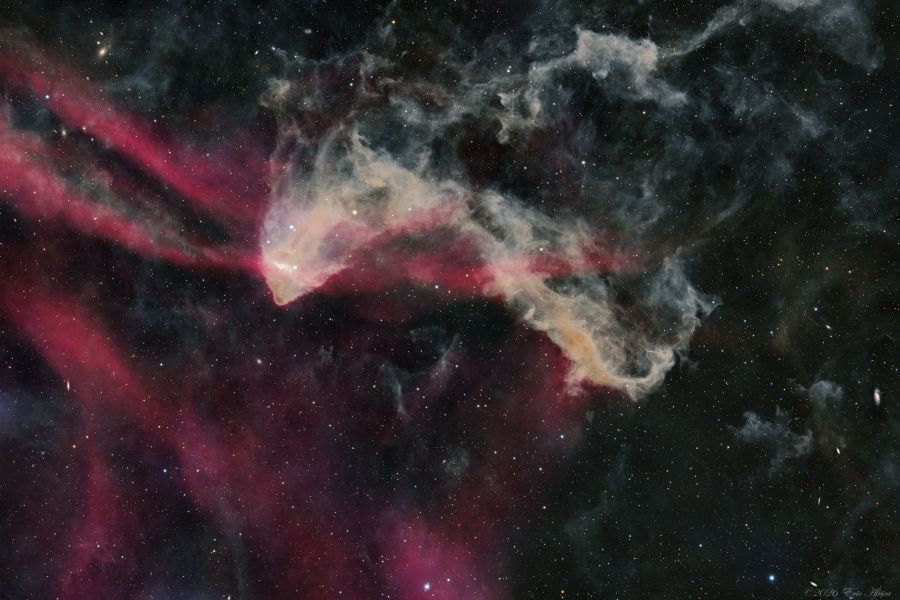
LBN 437 - Click on image to view larger image. Opens in a new window. |
| I only recently found out about this object in
2026. In researching this target (the 437th entry in the Lynd's
Bright Nebula catalogue), I discovered that the red nebulosity
around the target (which would make a nice hydrogen-alpha image
by itself) is part of Sharpless 126 (SH2-126), which extends
beyond this field of view. What caught my attention when I first saw this nebula was its nickname, The Flying Gecko nebula. I do see the flying lizard shape, with the "stellar funnel" at the left resembling a head and the rest of the nebulosity snaking away to the right its body. Additional nebulosity above the body does resemble the wings of the lizard. That said, what I almost immediately saw on looking at this image by Stuart Heggie (https://www.astrofoto.ca/stuartheggie/ccd_photos/LBN_437_ASI6200MCPro_AP110GTX_July2026.html) was Toothless the dragon from the "How to Train your Dragon" movies. Of course it's no stretch of the imagination to interpret an image of a flying lizard as a dragon, but what sealed the deal for me is the "ears", or "horns" sweeping back from the "head" of the lizard. Whimsy aside, Toothless' "head" forms a "stellar funnel" and his "body" curls away to the right. LBN 437 is a molecular cloud whose densest part is associated with some bright young stars. Its most striking feature is described as "a symmetrical reflection nebula associated with the star V375 Lacertae". This star is also responsible for the bipolar Herbig-Haro objects (small nebulae around young stars, formed when gas ejected by the star hits dust clouds) within the nebula. The most prominent one is HH 398, the bright knot closes to Toothless' "nose". There are other Herbig-Haro objects in that area, specifically HH 808, HH 811 and HH 812, which I don't believe are visible in this image or are at least tougher to resolve or identify. Link to Astrobin version. |
| Constellation: Lacerta |
| When Visible: June - November |
| Distance: 1,200 Light-years |
| Date: August 2026 |
| Location: Location: Starfront Observatories, Rockwood, Texas |
| Exposure Details:
L: 278 × 3 minutes R: 124 × 3 minutes G: 124 × 3 minutes B: 123 × 3 minutes 32 hrs 27 minutes total exposure |
| Equipment Used: Takahashi FSQ-106N on a ZWO AM5N mount. ZWO ASI-2600MM Pro camera with 7 x 50mm filter wheel and Antlia Pro filters. Externally guided with a ZWO ASI224MC camera on a William Optics UniGuide 50 guide scope. |
| Acquisition Software : Nighttime Imaging 'N' Astronomy, PHD2 |
| Processing Software: MaximDL, PixInsight, Photoshop CS5, IrFanView |