M42, the Orion Nebula (2026) |
||
 Click on thumbnails below to view larger image. Opens in a new window. |
||
|
||
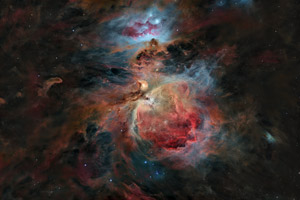
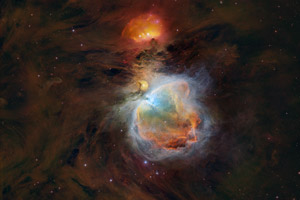
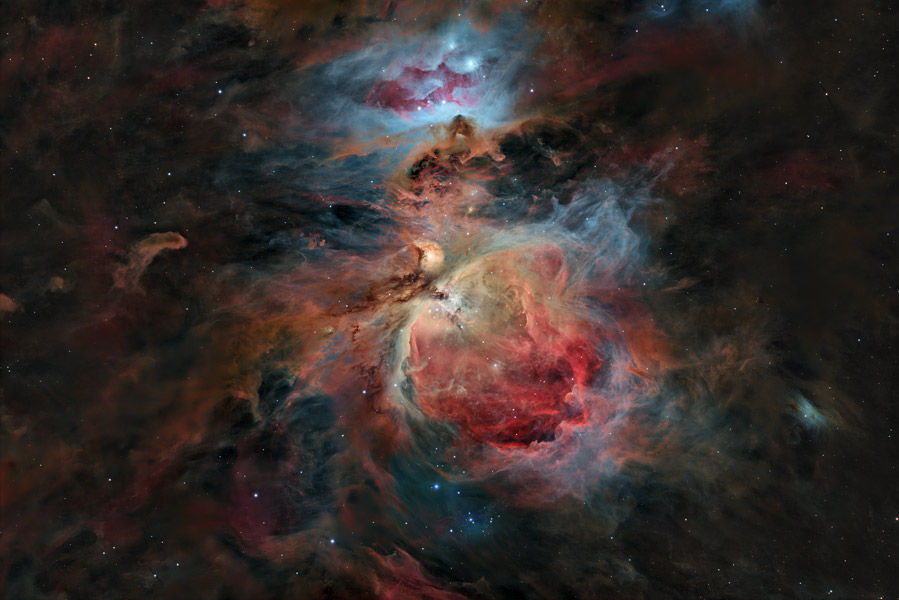
| I've probably taken many images of M42 over the years, but mostly to test equipment. The popularity of this object as a subject of many astrophotographers ironically put it low on my list to capture a deep exposure outside of my attempts in 2005 and 2019 (both of which were still relatively shallow). I finally decided to remedy that situation. Here is approximately 40 hours of data for M42, the Great Nebula of Orion.
Data for these images was taken across multiple nights from October, 2025 through February, 2026. Credit is due to the planning features provided by NINA (Nighttime Imaging N Astronomy) as well as planetarium software. For instance, on October 12, 2025 (the first night some data was accumulated for M42), I was gathering data for the Cocoon Nebula. Early in the morning, the sky was still clear but the Cocoon was no longer at a proper altitude for gathering good data. But M42 had risen to a favorable altitude, so I decided to start acquiring data for that target on that date. Broadband LRGB data was gathered as well as narrowband data. Both versions have been processed separately and are presented in this page. This 2026 treatment of narrowband data is presented as a nod/tribute to my 2005 effort , which had been used as an example of narrowband data processing (for better or worse) by fellow imagers who gave me credit (and for which I am honored - I will post links of these samples, which include educational videos, when I find them). One of the challenges of imaging M42 is that it is a high-dynamic range (HDR) target; this makes it challenging to capture an image of this object in full detail without either overexposing its central region (the Trapezium, referring to the trapezoidal formation of hte four brightest stars in that region) or underexposing the dimmer outer regions of this area. My image (much like many others who have successfully imaged this target) utilizes HDR techniques to bring out the best of both the bright and dim features of this object. The Trapezium area was captured using 2-second exposures for the LRGB data and 10-second exposures for the narrowband (Hubble Palette) rendition (details below). This data was combined with 3-minute (LRGB) and 10-minute (narrowband) exposures to create the composites presented above. RGB stars were used for both renditions. |
||
| Constellation: Orion | ||
| When Visible: December - April | ||
| Distance: 1,500 Light-years | ||
| Dates:
October, 2025 - February 2026 |
||
| Location:
Starfront Observatories, Rockwood, TX |
||
| Exposure Details: LRGB Version: Trapezium L = 192 x 2s (6m 24s) R = 161 x 2s (5m 22s) G = 156 x 2s (5m 12s) B = 162 x 2s (5m 24s) Outer Regions: L = 154 x 3 minutes (7h 42m) R = 137 x 3 minutes (6h 51m) G = 139 x 3 minutes (6h 57m) B = 133 x 3 minutes (6h 39m) Hubble Palette Version: Trapezium Ha = 72 x 10 (12m) SII = 48 x 10s (8m) OIII = 27 x 10s (4m 30s) Outer Regions: Ha = 23 x 10 minutes (3h 50m) SII = 24 x 10 minutes (4h) OIII = 22 x 10 minutes (3h 40m) |
||
| Equipment Used:
Takahashi FSQ-106N on a ZWO AM5N mount. ZWO ASI-2600MM Pro
camera with 7 x 50mm filter wheel and Antlia Pro filters. Externally guided with a ZWO ASI224MC
camera on a William Optics UniGuide 50 guide scope. |
||
| Acquisition Software : Nighttime Imaging 'N' Astronomy, PHD2 | ||
| Processing Software: MaximDL, PixInsight, Photoshop CS5, IrFanView | ||