SH2-129 and Ou4 - The Flying Bat and Squid |
||
 SH2-129 - Click on thumbnails below to view larger image. Opens in a new window. |
||
|
||
| Many deep sky objects have been nicknamed as a
bat in one form or another such as LDN 43..
This target, SH2-129, has been nicknamed the Flying Bat nebula,
which I personally don't see the shape of. Granted, this is a
large emission nebula that does not quite fit the field of view
of my scope/camera combination, though images showing the full
nebulosity still don't show the flying bat shape to me. I
haven't found any reference as to why this nebula was given this
nickname. Then again, other objects with similarly cryptic names
might have been called such because they were described visually
or from pre-digital images. An example being the Crab Nebula
(M1). In pre-photographic sketches M1 does bear a resemblance to
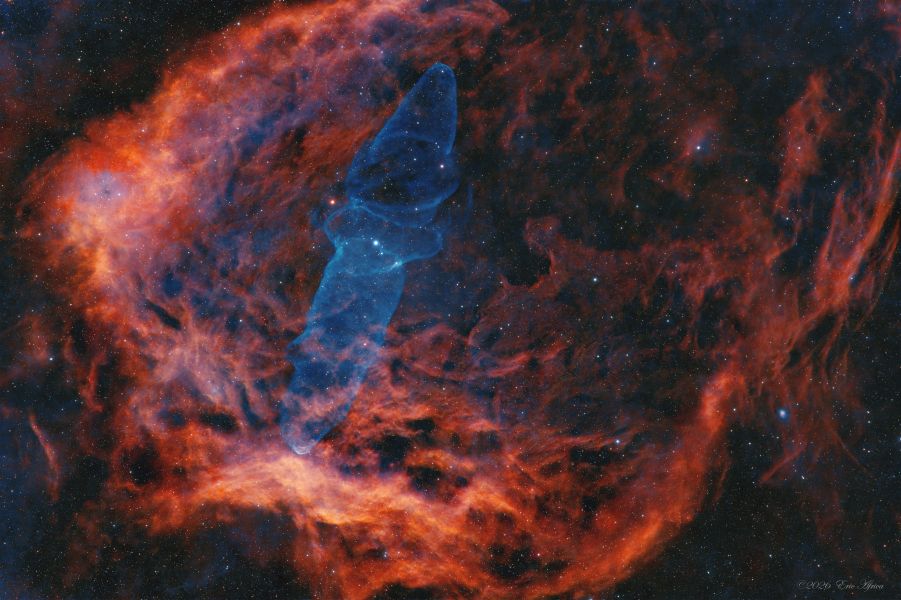
a crab. Perhaps the Flying Bat was similarly named? Prior to 2011, narrowband images of this nebula focused mostly on Hydrogen-Alpha (Ha)/RGB data, and many imagers who attempted collecting Hubble Palette data reported nothing to see in those wavelengths (e.g., http://www.sharplesscatalog.com/sharpless/SH2-129.aspx). However, in May 2011 French amateur astrophotographer Nicolas Outters made his attempt at this region using the Hubble Palette wavelengths. In processing his data he discovered an unusual object in his OIII data. His discovery was confirmed by French astrophysicist Agnes Acker and designated Ou4, which marks this as the fourth nebula discovered by Outters. Ever since his discovery, every narrowband imager has made sure to capture Oiii data in this region to ensure that they include Ou4 in their image. Outters himself described his discovery as "Le Calamar" (the Squid), so that name for this discovery stuck! I actually made an attempt back in 2012 but have not released it. Until now. Note that even though the field of view in 2012 is slightly larger than the 2026 version, the full-size image of the 2012 version is smaller despite having used the same telescope for both images. This is a natural consequence of the camera used in 2012 (SBIG STL-6303) having a larger chip but smaller pixels than the camera used in 2026. So here is my attempt at the Flying Bat and Squid nebulae. This represents over 90 hours of exposure through narrowband filters taken over several nights from March through August 2026. As a bonus, I am also including my attempt from 2012 with comparatively shallow data. For both renditions, I am applying a modified SHO palette which maps H-alpha to Red, OIII to green and blue and SII to orange. I tried the classic SHO palette but find this modified palette a bit more pleasing to me. Link to 2026 version on Astrobin. |
||
| Constellation: Cepheus | ||
| When Visible: August - January | ||
| Distance: 2,000 Light-years | ||
| Date: July - August 2026 | ||
| Location: Location: Starfront Observatories, Rockwood, Texas | ||
| Exposure Details:
H-alpha: 202 × 10 minutes SII: 138 × 10 minutes OIII: 146 × 10 minutes 81 hrs total exposure |
||
| Equipment Used: Takahashi FSQ-106N on a ZWO AM5N mount. ZWO ASI-2600MM Pro camera with 7 x 50mm filter wheel and Antlia Pro filters. Externally guided with a ZWO ASI224MC camera on a William Optics UniGuide 50 guide scope. | ||
| Acquisition Software : Nighttime Imaging 'N' Astronomy, PHD2 | ||
| Processing Software: MaximDL, PixInsight, Photoshop CS5, IrFanView | ||
| 2012 Version: Takahashi FSQ-106N on Astro-Physics AP1200GTO mount. SBIG STL-6303 with Astrodon Narrowband filters. Imaged September 2012. H-alpha: 9 x 30 minutes. SII: 9 x 30 minutes. OIII: 8 x 30 minutes. |