
vdb 152 - Wolf's Cave Nebula |
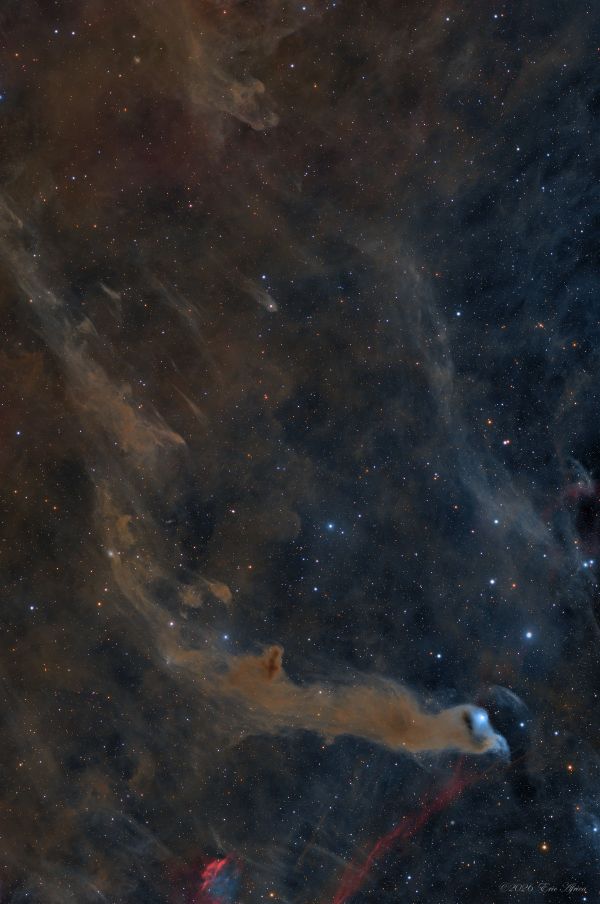
vdb 152 - Click on image to view larger image. Opens in a new window. |
| This area in the constellation Cepheus displays
a motley collection of reflection nebulae, dark nebulae and a
portion of a planetary nebula as well as a small section of an
ancient supernova remnant. vdb 152, which this image is called, actually references just the bright, somewhat duck-faced blue nebulosity at the end of the prominent dark nebula. The long red nebula that touches the "bill" of the "duck" is a section of supernova remnant SNR 110.3+11.3. And the red/blue region next to that supernova remnant is planetary nebula Dengel-Hartl 5. None of which I had expected to capture in any detail in this image hence the cut-off of both objects in this presentation. The long dark nebula snaking behind vdb 152 is catalogued as Barnard 175 I mentioned a few object types captured in this image. To summarize what each of those is: Reflection nebula (vdb 152): clouds of dust reflecting the light from a bright star in its vicinity. Reflection nebulae tend to be blue for the same reason a clear sky on Earth is blue: preferential scattering of blue light. Dark nebula (Barnard 175): thick clouds of dust and gas obstructing the light of stars behind them (from our perspective). Supernova remnant (SNR 110.3+11.3): clouds of material ejected from a supernova explosion, sweeping up and shocking interstellar material encountered as the shock wave travels through space. Supernovae are either massive stars (containing at least 8 or more times the mass of the Sun) that collapse when they can no longer sustain nuclear fusion, or a white dwarf star in a binary (two-star) system that orbits close enough to capture matter from its partner; if it collects too much mass from that companion, it detonates in a manner similar to collapsing massive stars. Planetary nebula (Dengel-Hartl 5): an expanding shell of ionized gas ejected from a star similar to the mass of the sun (and up to 8 times the Sun's mass). At the late stages of such a star's life, when its core runs out of hydrogen to sustain nuclear fusion, the star first expands to a red giant as its core collapses under the weight of the star; the collapse fuels a temporary surge of fusion that uses up the remaining hydrogen. This collapse can also trigger a temporary secondary fusion reaction as conditions allow for helium fusion to occur. The combined surge in fusion is what causes the star to turn into a red giant. This fusion surge is unsustainable; a star is a red giant for only a fraction of its life as a main-sequence star (about a few hundred million years to a billion years vs 10 billion as a main-sequence star). Beyond that stage, the outer atmosphere of the red giant is ejected into space as the core of the star is left behind as a white dwarf. Ultraviolet radiation from the white dwarf excites the atoms of the ejected red giant atmosphere, and it is this glow that we see as planetary nebulae. I was puzzled by the naming of this nebula (where is the wolf and where is the cave?). On further research, I found out that "Wolf" actually refers to German astronomer Maximilian Franz Joseph Cornelius Wolf. This region was photographed October 21, 1908, and Wolf's assistant, August Kopff discovered this structure. Wolf saw a cave in the picture and called it the Cave Nebula. It was eventually referred to as Wolf's Cave, I presume partially to differentiate it from what many astronomers know as *the* Cave Nebula, SH2-155. vdb 152 in my eyes looks like the head of a duck (a friend referred to it as a goose); Barnard 175 looks like the body of a slug, with the cloud behind it resembling the slime trail left by said slug. So in my personal pareidolia, this object can be described as a "duck-headed slug". Link to Astrobin version. |
| Constellation: Cepheus |
| When Visible: August - January |
| Distance: 1,400 Light-years |
| Date: August 2026 |
| Location: Location: Starfront Observatories, Rockwood, Texas |
| Exposure Details:
L: 204 × 3 minutes R: 112 × 3 minutes G: 118 × 3 minutes B: 120 × 3 minutes 27 hrs 42 minutes total exposure |
| Equipment Used: Takahashi FSQ-106N on a ZWO AM5N mount. ZWO ASI-2600MM Pro camera with 7 x 50mm filter wheel and Antlia Pro filters. Externally guided with a ZWO ASI224MC camera on a William Optics UniGuide 50 guide scope. |
| Acquisition Software : Nighttime Imaging 'N' Astronomy, PHD2 |
| Processing Software: MaximDL, PixInsight, Photoshop CS5, IrFanView |